
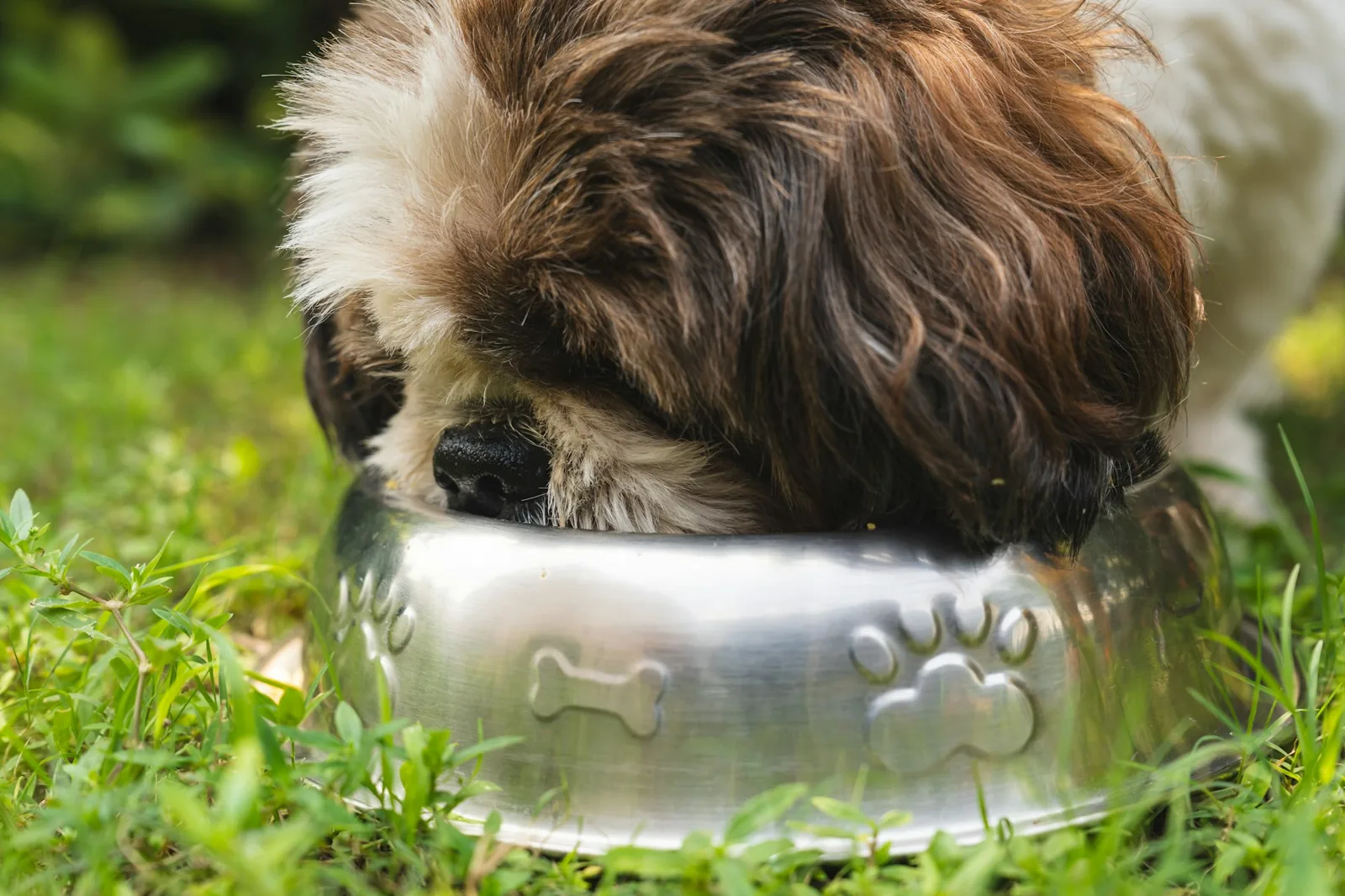
For most fast-eating dogs, the best stainless steel slow feeder dog bowl is the OurPets DuraPet Slow Feed Bowl: a heavy steel bowl with a solid center hump and a rubber ring bonded to the base, sold in three sizes and rated 4.5/5 from 5,135 Amazon ratings (October 2026). If your dog has already beaten simple hump bowls, a maze-style steel bowl like the Feedoo double-wall model is the harder step up.
The size matters more than the brand. A slow feeder only works when the whole meal sits in the channels instead of piling on top, so this guide sorts every bowl by its listed capacity and tells you where the listings disagree with themselves.
We may earn a commission when you buy through links on this page, at no extra cost to you. As an Amazon Associate we earn from qualifying purchases. It doesn’t change which products we recommend.
How we chose
We didn’t test these bowls with our own dogs. We compared the manufacturer specs on each Amazon listing (capacity, dimensions, base type, cleaning instructions), the aggregate Amazon ratings, and the warnings sellers print on their own listings. We only included bowls that are stainless steel where the food touches, have at least a few hundred ratings, and state a capacity. Ratings and specs were checked on October 22, 2026; prices change too often to print, so each pick links to the current listing.
Comparison table
| Bowl | Obstacle type | Listed capacity | Base | Amazon rating (Oct 2026) |
|---|---|---|---|---|
| OurPets DuraPet Slow Feed | Solid center hump | S / M / L; labeled 2, 4.5 and 6 cups (bullets say up to 3, 5 and 8) | Bonded skid-proof ring | 4.5/5, 5,135 ratings (Medium) |
| Neater Pet Brands Slow Feed Bowl | Raised peaks | 0.75 to 5 cups; 3-cup is 8.25″ wide, 2.75″ high | Standard or Non-Tip versions | 4.4/5, 7,475 ratings (3-cup) |
| Mr. Peanut’s Interactive Slow Feed | Bundt-style center ring | S 1.5, M 2, L 3 cups dry food | Silicone base | 4.4/5, 1,957 ratings (Medium) |
| Feedoo Double-Wall Slow Feeder | Spiral maze | S 1-1.5, M 2-2.5, L 3-3.5, XL 4-4.5 cups | Non-slip rubber base | 4.5/5, 1,408 ratings (M) |
| Novery Slow Feeder | Bone-shaped ridge, reversible | 2 cups; 8.6″ wide, 1.6″ deep | Rubberized bottom | 4.2/5, 571 ratings |
Size it first: the one-size-up rule
Measure one meal with a real measuring cup, then buy the bowl whose listed capacity is at least that number, and preferably one size up. Slow feeder capacity is the amount that fits in the bowl, not the amount that still sits low in the channels. A 2-cup bowl holding 2 cups of kibble is full to the rim, and a dog can skim the top layer as fast as from a flat dish. A dog eating 1.5 cups per meal is better served by a bowl listed at 2 to 3 cups.
Also check the depth. Short-nosed breeds such as pugs and French bulldogs struggle with deep mazes, so the Novery (1.6″ deep) or a hump bowl is a gentler start than a tight spiral.
1. OurPets DuraPet Slow Feed Premium Stainless Steel Bowl: best overall
The DuraPet has one obstacle: a solid steel dome in the middle, so the dog has to eat around the edge. That sounds too simple, but it is the design most dogs accept on day one, and the bonded ring on the bottom is meant to stop sliding and tipping.
Who it’s for: medium and large dogs new to slow feeders, and owners who want one piece of steel with no insert to lose.
Who should skip it: dogs who already clear puzzle bowls quickly, since a single hump is the easiest pattern to beat.
- Pro: the anti-skid ring is permanently bonded rather than a loose silicone sleeve.
- Pro: dishwasher safe, according to the listing.
- Pro: three sizes, with the Large aimed at big-meal dogs.
- Con: the listing contradicts itself on capacity. Size labels say 2, 4.5 and 6 cups; the bullet points say up to 3, 5 and 8 cups. Go by the lower number when sizing.
- Con: Amazon flags it as a “frequently returned item,” so read the recent reviews for your size before ordering.
2. Neater Pet Brands Stainless Steel Slow Feed Bowl: best for raised feeders
Neater’s bowl is the one to pick if you already own a raised stand. The 3-cup version is listed at 8.25″ in diameter and 2.75″ high, and it fits the Neater Feeder Deluxe Large, the Neater Feeder Express Medium to Large, and other stands with a bowl opening between 7.25″ and 8″. It comes in 0.75, 1, 1.5, 3 and 5-cup sizes, with a separate Non-Tip version.
Who it’s for: owners replacing the plain bowl in a stand, and anyone who wants the most-reviewed bowl in this list.
Who should skip it: owners of large, deep-chested dogs who are only buying a stand because they think raised feeding prevents bloat (see the bloat section below).
- Pro: the widest size range here, from 0.75 to 5 cups.
- Pro: Neater says it’s designed to slow dogs down “without driving them crazy,” which suits nervous eaters.
- Pro: listed for both wet and dry food.
- Con: the Standard version is built to sit inside a stand; for floor feeding, the listing offers a separate Non-Tip version, so pick the right one.
- Con: it fits only specific Neater stand sizes, which the listing spells out in capitals. Measure your stand’s opening first.
3. Mr. Peanut’s Stainless Steel Interactive Slow Feed Bowl: best budget pick
Mr. Peanut’s uses a Bundt-cake shape: kibble circles a raised center ring, and the dog has to chase it around. The listing gives clear capacities (Small about 1.5 cups, Medium 2 cups, Large about 3 cups of dry food) and says the steel is food safe and made in India.
Who it’s for: small and medium dogs, and owners who want to try a slow feeder cheaply before buying a harder one.
Who should skip it: anyone who hand-washes and air-dries dishes in a rack.
- Pro: three clearly stated sizes for dry food.
- Pro: dishwasher safe and shatterproof, per the listing.
- Con: the seller’s first bullet warns you to dry the bowl fully after washing, or rust spots can form in the crevice between the silicone base and the metal.
- Con: the spec table lists dry food as the recommended use, while the bullets say wet or dry. A one-ring design is also easy for experienced dogs.
4. Feedoo Double-Wall Slow Feeder: best for experienced fast eaters
The Feedoo bowl swaps the single hump for a spiral maze, which forces more nose work per bite. It is double-wall food-grade stainless steel with a non-slip rubber base, and it comes in four sizes: S (1 to 1.5 cups), M (2 to 2.5), L (3 to 3.5) and XL (4 to 4.5).
Who it’s for: dogs who empty a hump bowl in seconds and need a tighter pattern.
Who should skip it: flat-faced breeds and first-time slow feeder users, who may get frustrated with a maze.
- Pro: the four-size range makes it easy to apply the one-size-up rule.
- Pro: the double wall adds weight, so the bowl is harder to push around.
- Pro: marked Amazon’s Choice when we checked, with 4.5/5 from 1,408 ratings.
- Con: the most expensive bowl in this list at the time we checked.
- Con: tight spiral channels take more scrubbing after wet food than a hump bowl does.
5. Novery Non-Slip Stainless Steel Slow Feeder: best shallow option
Novery’s bowl is shallow, 8.6″ across and 1.6″ deep, with a raised bone-shaped ridge in the base. Flip it over and the underside works as a lick surface for yogurt or peanut butter.
Who it’s for: medium dogs eating up to about 1.5 cups per meal, short-nosed dogs, and cats.
Who should skip it: large dogs with big meals, since 2 cups is the only size.
- Pro: shallow depth suits flat-faced breeds.
- Pro: the reversible design adds a second use.
- Pro: rubberized bottom to reduce sliding.
- Con: the lowest rating in this list, 4.2/5 from 571 ratings.
- Con: one size only, and a low ridge slows dogs less than a maze does.
Do slow feeders prevent bloat? What the evidence says
Many listings promise a slow feeder “prevents bloat.” The evidence is weaker than that. The American College of Veterinary Surgeons says gastric dilatation-volvulus (GDV) is multifactorial but commonly associated with rapid eating of large meals, and lists a single large meal once a day as a risk factor. A 2000 study of large and giant breeds (Glickman et al.) found faster eating linked to higher GDV risk. A 2016 evidence summary in Veterinary Evidence concluded that most studies found no effect of eating speed, that none found slow eating harmful, and that there isn’t enough evidence to decide either way.
The same Glickman study found a raised feeding bowl associated with higher GDV risk, and Cornell’s Riney Canine Health Center lists raised bowls among bloat risk factors. That matters if you’re buying the Neater bowl for a stand: for a large, deep-chested dog, a floor-level slow feeder is the safer choice to discuss with your vet.
The honest summary: a slow feeder is low-risk and may help, but splitting food into two or more meals and avoiding hard exercise right after eating are the changes the bloat literature points to more consistently. Our guide to how much exercise your dog needs covers how to plan walks around meals. Bloat is an emergency; a dog retching without producing anything, with a swollen belly, needs a vet immediately.
How to choose: a quick decision guide
- First slow feeder, medium or large dog: OurPets DuraPet, sized by the lower capacity number.
- You own a Neater or other raised stand with a 7.25″ to 8″ opening: Neater Pet Brands, after checking the bloat section if your dog is a large breed.
- Small dog or tight budget: Mr. Peanut’s Small or Medium, dried fully after each wash.
- Dog finishes hump bowls in under a minute: Feedoo spiral, one size above the meal.
- Pug, Frenchie or cat: Novery, the shallowest bowl here.
If you’re setting up a puppy’s feeding station, a slow feeder can start from the first week; it sits well alongside the items in our first-year puppy checklist. If you feed on a timer instead, read whether automatic feeders are worth it, because most of them dispense into a flat tray rather than a slow feeder.
Keeping a steel slow feeder clean
Stainless steel doesn’t scratch the way plastic does, but slow feeders have corners that flat bowls don’t. Rinse wet food out right after the meal, before it dries in the channels. For bowls with a separate silicone or rubber base, pull the base off if it’s removable and dry the seam, which is where Mr. Peanut’s own listing warns rust spots can form. If a bowl develops rust that won’t scrub off, replace it. We use the same “how much is really steel” check in our stainless steel cat fountain guide: look at what touches the food, not just the product title.
FAQ
Are slow feeders good for dogs?
For dogs that gulp, a slow feeder lengthens the meal and adds a small puzzle. The research on bloat is mixed, but no study in the 2016 Veterinary Evidence summary found slow eating harmful. Supervise at first and stop if your dog gets frustrated.
Is stainless steel better than plastic for a slow feeder?
Steel can’t be chewed into pieces the way plastic ridges can, and it doesn’t crack. Its weak spot is the seam where a rubber or silicone base meets the metal, which needs drying after every wash.
Can I use a slow feeder for wet food?
The Neater and Novery listings name wet food as a use. Simpler shapes (a hump or ridge) clean out more easily after wet food than tight mazes.
What size slow feeder does my dog need?
Measure one meal and choose a bowl listed for more than that amount. When a listing gives two capacity numbers, as the OurPets bowl does, size by the smaller one.
Sources
All checked October 22, 2026.
- Amazon listing ASIN B001NJ4PVW (OurPets DuraPet, Medium): sizes and capacities, bonded ring, dishwasher safe, rating and count, returns flag.
- Amazon listing ASIN B015G2DU80 (Neater Pet Brands, 3 cup): dimensions, stand compatibility, size range, wet/dry use, rating and count.
- Amazon listing ASIN B073NF681T (Mr. Peanut’s, Medium): sizes, rust warning, made in India, rating and count.
- Amazon listing ASIN B0D1FMP3S5 (Feedoo double-wall, M): sizes, double-wall build, rubber base, rating and count.
- Amazon listing ASIN B0F8HHWF9K (Novery, 2 cups): dimensions, reversible design, rating and count.
- American College of Veterinary Surgeons, Gastric Dilatation-Volvulus: acvs.org
- Glickman LT et al. (2000), Non-dietary risk factors for GDV in large and giant breed dogs, JAVMA 217(10): PubMed 11128539
- Buckley LA (2016), Are dogs that eat quickly more likely to develop GDV?, Veterinary Evidence: veterinaryevidence.org
- Cornell Riney Canine Health Center, GDV or bloat: vet.cornell.edu
- Owner notes / photos: none.